%201.png?width=146&height=103&name=Slice%203%20(72)%201.png "JV Logo")


As industries crucial to the global economy continue to evolve, the manufacturing techniques driving this growth are becoming increasingly advanced. Among these cutting-edge innovations is electrochemical machining (ECM), a technique that exemplifies the leap forward in precision and efficiency.
Just as ECM is an evolution of traditional machining, it has itself evolved into variants that produce more precise components, including precision electrochemical machining (PEM or PECM).
In this blog, we’ll break down the key differences between PEM and traditional ECM methods and outline when each is best.
What Is Precision Electrochemical Machining (PEM) vs. Traditional ECM?
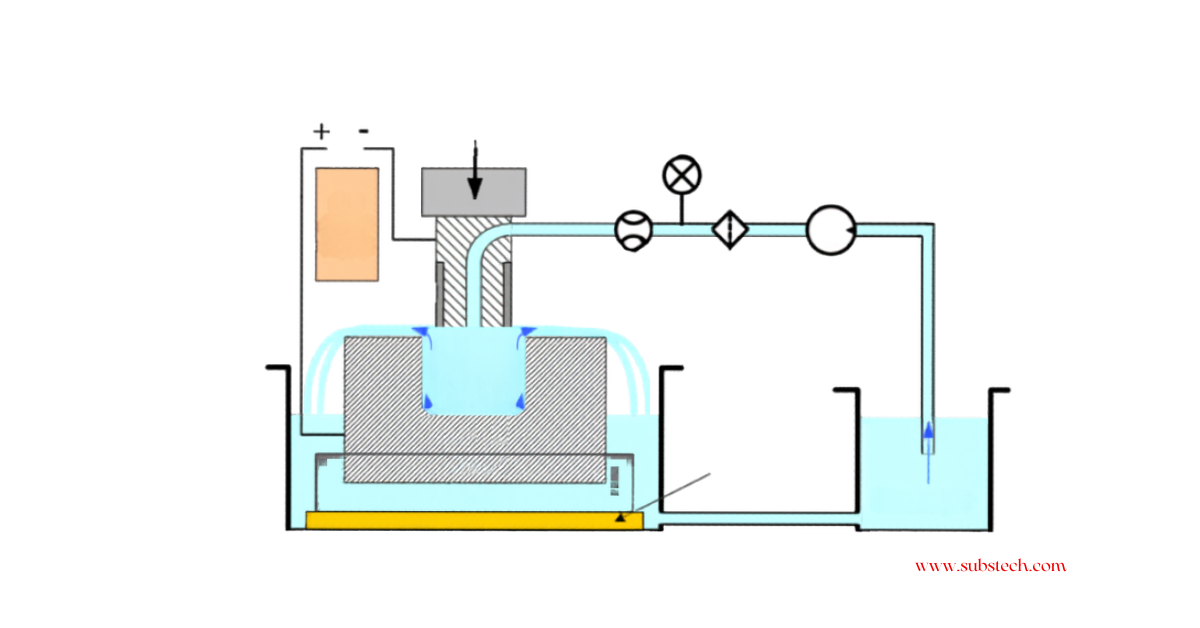
ECM is a non-contact machining method that removes material through a chemical process and electrical energy rather than by physical forces such as grinding or milling, as traditional machining methods do.
Also known as precision electrolytic machining (PEM, PECM), it is a refined form of ECM. It uses pulsed current and extremely tight gap control between the tool and the workpiece to remove material with high accuracy. This method achieves tighter tolerances, better dimensional accuracy, and superior finishes than traditional ECM.
Traditional ECM uses the same electrochemical process to dissolve material but lacks the same precision. It’s often better suited to less complex geometries with few intricate features and looser tolerance requirements.
|
The JV Difference: One Machine, Dual Capabilities It’s a common misconception that choosing a shop with advanced PECM capabilities means they only handle ultra-precise, complex microfeatures. At JV Manufacturing, our advanced PECM equipment is highly versatile. While they represent the cutting edge of precision technology, our machines can be programmed to operate like traditional ECM systems simply by adjusting the software settings. This means you get the best of both worlds: access to extreme precision when your design demands it, and cost-effective, high-volume traditional ECM when it doesn't. |
Key Differences Between PEM vs. Traditional ECM
Below, you’ll find a chart with the key components of each method. Then, we’ll dive deeper into each key difference.
|
ECM |
PEM |
|
|
Definition |
A non-contact machining method that uses an electrochemical reaction to remove material from a workpiece |
An advanced form of ECM, using a tight pulse control to produce components with extreme accuracy |
|
Process |
Continuous current in an electrolyte drives electrochemical material removal |
Pulsed (localized) electric currents and tight gap control between a workpiece (anode) and tool (cathode) |
|
Ideal volumes |
High volumes with excellent repeatability for simpler geometries |
High volumes with repeatability for complex geometries |
|
Tolerances |
±0.025-0.1 mm on contoured features |
Around ±5 µm / 0.0002 in on suitable geometries |
|
Geometries |
Best for larger, less intricate designs |
Best for complex geometries with microfeatures, thin walls, etc. |
|
Finish |
Smooth, burr-free finishes with a greater chance of needing post-processing |
Superior finish with lesser need for post-processing |
|
Cost |
Cost-effective for larger volumes with less complex shapes |
Higher costs upfront, but often more cost-effective for complex designs |
|
Applications |
Aerospace, medical, automotive, manufacturing, energy |
Similar industries, but most common with projects requiring strict tolerances and intricate geometries |
Process
In traditional electrochemical machining, an electrolyte solution is placed between the workpiece (anode) and the custom tool (cathode). A continuous electrical current is applied to create an electrochemical reaction that dissolves material from the workpiece. Then, excess material is flushed away, creating the desired shape.
PEM works similarly, but uses a pulsed electrical current rather than a continuous one. This creates a localized, controlled current that enables more precise material removal, resulting in fewer miscuts, less waste, and higher accuracy.
Ideal Volumes
While both PEM and traditional ECM are suitable for high-volume production, traditional ECM is better suited to simpler geometries and more flexible tolerances. PECM, on the other hand, can be ideal for production volumes ranging from low to high. That’s because, in most cases, the primary consideration for PECM is precision over repeatability or production speed.
Tolerances
The continuous electrical currents used in the traditional ECM process result in lower tolerances than those of PECM. More specifically, conventional ECM can achieve tolerances within a range of ±0.025-0.1 mm on contoured features, while PECM can achieve tolerances approximately 5-20 times tighter – around ±5 µm / 0.0002 in on suitable geometries.
This makes PEM a no-brainer for applications where precision is critical, like the aerospace and medical industries.
Geometries
Traditional ECM is more suitable for large parts with simple geometries, while PEM is ideal for components with finer details. Below are some examples of features PEM can achieve that traditional ECM machining can’t:
- Small-radius holes and other cavities
- Sharp or 3D internal features
- Defined edges
Finish
Traditional ECM can produce smooth surfaces without burrs or major imperfections, but often still requires post-processing. PEM, however, often reduces the likelihood of secondary finishing, as its final result achieves a higher-caliber finish right out of the machining process.
Cost Considerations
It’s important to note that neither ECM nor PEM is universally more or less expensive than the other. But in general, ECM is usually more cost-efficient for bigger parts with simple designs than PEM. PEM typically comes with higher upfront and operational costs, but its superior finish can prevent the additional cost of secondary finishing that ECM may have required.
Other factors will impact the total cost per part, such as design, tooling, and setup costs, which can vary by technology and manufacturer.
Applications
Since it’s suitable for high-volume parts with repeatability and durability, ECM applications typically include producing high-strength components for critical industries like aerospace, medical, energy, and automotive – more specifically: turbines and blades for aerospace components and energy sectors.
PEM will serve similar industries, but will be more useful for parts requiring more complex designs and internal features – such as turbine blade cooling channels composed of tiny internal cavities or highly sharp, microscopic medical devices – that traditional ECM cannot achieve.
When to Choose PEM vs. ECM
So when does each make sense for your project? In short, choose PEM when:
- Tolerances are tight
- Geometries are complex with microfeatures or extremely sharp edges
- Designs are for extremely small parts
- A superior surface finish is required
Choose traditional ECM when you’re dealing with:
- Large parts with simple designs
- Looser tolerance requirements
- Larger volumes of material removal
- Large production volumes of repeated components
- Limited budget
FAQs: Comparing PECM and Traditional ECM
Have more questions about ECM, PEM, or how they compare to other methods of ECM? Read the answers to these frequently asked questions below.
Are PEM and PECM the same thing?
What are the similarities between PEM and traditional ECM?
What are the advantages of PECM over traditional ECM?
|
Partner with a PEM Expert
While both PEM and ECM are smart manufacturing methods using non-contact electrochemical material removal, you don't have to choose between two different partners. At JV Manufacturing, our advanced PECM equipment handles both processes seamlessly.
Whether your project calls for high-volume production of larger parts with simpler designs, or microscopic medical devices with tight tolerances, our dual-capable machinery is programmed to deliver exactly what you need
Ready to revolutionize your manufacturing process? Connect with a leading PEM manufacturer today and elevate your parts to new heights of quality and precision, guaranteed to meet or surpass the most stringent industry standards.

.png)
Intro to Electrochemical Machining
ECM Vs. EDM Machining: What’s the Difference?